


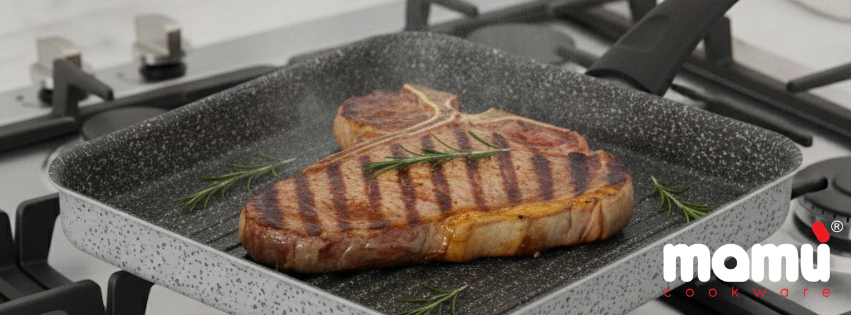
If there is a scene that repeats itself in almost every kitchen, it is this one: you buy a nice cut of meat, put it in the pan with the best of intentions, and... drama. Within minutes, the meat's juices start pouring out, creating a puddle at the bottom of the pan. The result? You aren't grilling the meat; you are essentially boiling it. The flavor changes, the texture becomes tough, and that much-desired crispy crust vanishes into thin air.
Yet, the solution is often right in front of our eyes. If you look closely at the surface of a Mamù grill pan or a Mamù hamburger press, you will notice a series of precise design elements: geometric grooves and small raised dots. These are not random aesthetic or decorative details. They are true functional innovations designed to revolutionize your everyday cooking.
The Grill Pan and Its Grooves: Anatomy of an Indoor Barbecue
Why does a quality grill pan feature those raised lines?
When we cook meat, high temperatures cause the muscle fibers to contract, releasing liquids and fats. If we used a completely smooth surface, the meat would constantly remain submerged in its own boiling juices.
The grill pan grooves serve a crucial dual purpose:
- The Elevation Effect: They lift the meat away from the bottom of the pan, preventing it from "boiling" in its own released liquids.
- Drainage Channels: They allow excess fat and juices to flow away from the food to the sides, drastically reducing smoke and annoying splatters during cooking.
The result? Even cooking, an optimal Maillard reaction, and those classic, beautiful chef-style grill marks that instantly make your mouth water.
The Hamburger Press and Its Dots: Small Details, Big Performance
While the grill pan uses lines, the Mamù hamburger press relies on a geometric pattern of small raised dots.
Hamburgers, by nature (especially artisan ones or those with a good percentage of marbling), tend to release a lot of fat during cooking. The dots distributed across the surface create a micro-air gap and support structure underneath the meat.
This system allows fat to instantly slide away from the contact points, preventing the meat from heavily frying in its own grease or sticking to the bottom of the pan. The surface stays clean, the outer crust of the burger becomes irresistible, and the inside remains perfectly juicy.
Made in Italy Quality by Mamù
Of course, geometry is not enough if the material isn't up to par. Mamù cookware lines stem from a long Italian manufacturing tradition, designed for those who love to cook without compromise.
Using high-quality aluminum tools equipped with advanced non-stick coatings (PFOA-free) ensures perfect and consistent heat distribution across the entire surface, while also making post-meal cleanup a breeze.
Want to take your cooking to the next level?
Discover the products mentioned in this article and experience the difference of cooking designed down to the smallest detail:
- Explore the convenience of the Mamù Grill Pan for your indoor barbecues.
- Upgrade your preparations with the Mamù hamburger press for sandwiches worthy of a gourmet house.


