


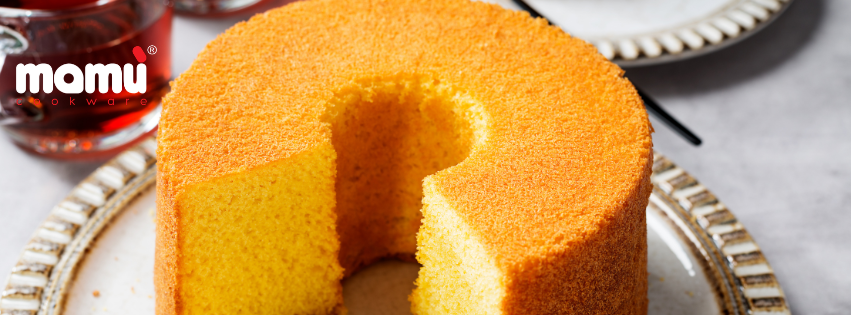
Chiffon cake is the dessert that makes everyone ask "how is it so tall?". Born in the United States, it has become a favourite in kitchens everywhere: cloud-soft, incredibly light, with a crumb you can squeeze between your fingers and watch spring back like a sponge. The catch is that it can collapse the moment it leaves the oven. In this guide we explain what it is, how to get that texture and why the pan matters as much as the recipe.
What chiffon cake is and why it's so soft
Chiffon cake is an American bake made with flour, sugar, eggs, vegetable oil and water or fruit juice. Unlike sponge cake it contains no butter, and unlike angel food cake it uses the yolks too. The result is a batter that is both moist and feather-light.
The secret to its height is egg whites whipped to stiff peaks and folded in gently. The trapped air expands in the oven and pushes the cake right up to the rim of the pan.
- Texture: spongy, airy and springy, with a fine, even crumb.
- Softness: using oil instead of butter keeps it moist for days.
- Fragility: the structure is so light that, while warm, it can't hold its own weight. This is where the right tool comes in.
Watch the video: Annachiara shares her chiffon cake secrets
Before you read on, watch Annachiara's video. She shows you step by step how to make the batter, how to fold in the whites without knocking out the air and how to use the pan, from baking to cooling upside down.
The chiffon cake pan: how it's made and why
The Mamù aluminium Angel Food Cake Pan is designed specifically for this cake. Every detail has a purpose.
1) The conical centre tube
A batter this tall, in a solid pan, would stay raw in the middle while the edges dry out. The conical centre tube carries heat right into the heart of the cake, so it bakes evenly and rises straight up without sinking in the middle.
2) Aluminium with no non-stick coating
The pan is made of 99.5% pure aluminium with no non-stick coating. It sounds odd, but it's exactly what you need: as it rises, the batter has to cling to the sides to climb. On a slick or greased surface it would slide back down. That's why a chiffon cake pan should never be buttered or floured. Aluminium also conducts heat well for even baking.
3) The cooling feet
As soon as it comes out of the oven, a chiffon cake must be turned upside down straight away. While warm it is still too delicate: left upright, its own weight crushes it and it deflates. Upside down, it hangs from the sides it has gripped and keeps all its height. The feet hold the pan off the counter, let air circulate and stop the top of the cake from touching the surface. Leave it to cool completely like this, for at least a couple of hours.
4) The removable base
Once cool, run a thin spatula around the sides and the tube: the removable base lets you release the cake without damaging its delicate structure.
Why a regular cake tin ruins the result
Many people try chiffon cake in the tin they already own and end up disappointed. Here's why.
- Springform tin: it has no centre tube, so the middle bakes poorly, and it can't be turned upside down. The runny batter may also leak through the clasp.
- Greased or non-stick tin: the batter can't grip the sides, rises less and, once inverted, comes away and drops out.
- Classic ring mould: too shallow for this batter, and you can't cool the cake upside down.
Either way the outcome is the same: a cake that sinks, short and dense, nothing like the cloud you had in mind.
Mamù's tip: try the recipe with the right pan
We are a family business and we make our own bakeware, in Italy. The Mamù Angel Food Cake Pan comes in three sizes, 24, 26 and 28 cm, and has everything a chiffon cake needs: centre tube, pure aluminium, cooling feet and a removable base.
Watch Annachiara's video, gather your ingredients and give it a go: the first time you take a tall, fluffy chiffon cake out of the oven, you'll see why the pan makes all the difference.


