


Let’s be honest: how many times, while cooking, do you just grab the first pot or pan you find in your kitchen drawer? "Yeah, just hand me that frying pan over there" is a classic phrase heard in almost every kitchen.
The problem is, very often, the one you just picked up is not a frying pan at all.
Today we want to clear up one of the most common, yet underestimated, mistakes made at the stove: confusing a frying pan (padella) with a sauté pan/stew pot (tegame).
Using the wrong tool isn’t just a minor oversight—it can actually ruin the cooking process and the final flavor of your dishes. Let’s do a quick recap!
🍳 The Frying Pan: The Queen of Fast Cooking
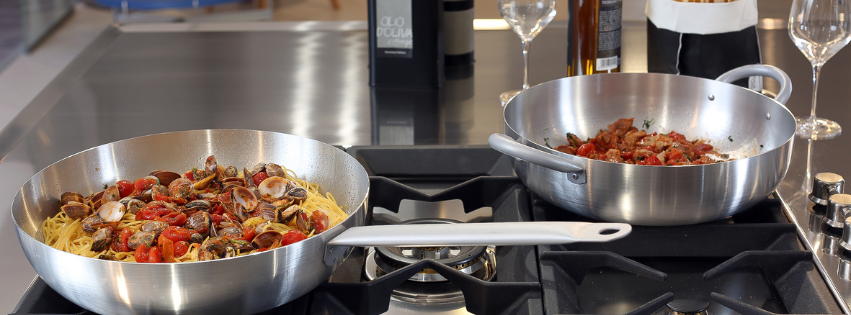
A frying pan is easy to recognize at a glance: it features a single long handle and low, flared sides.
Its structure is specifically designed for one purpose: to allow air to circulate quickly and to let you toss and move food with ease. It is the perfect tool for:
- Tossing pasta at the end of cooking to perfectly emulsify the sauce.
- Cooking flawless omelets and frittate (thanks to the low sides that allow for that perfect wrist-flip action).
- "Flash" cooking over high heat, such as searing meat or stir-frying crunchy vegetables.
🥘 The Sauté Pan (Tegame): The Specialist for Slow Cooking
If you look at it and it has two short loop handles on the sides and high, straight walls, then you are looking at a sauté pan or stew pot.
Unlike a frying pan, this pot is designed to retain moisture and distribute heat slowly and evenly across the entire surface. It becomes your best ally for:
- Sunday sauces and meat ragùs that need to simmer gently for hours.
- Stews, braised meats, and risottos, which require plenty of space to absorb liquids and cook gently without drying out too quickly.
💡 The Mamù Secret for Your Kitchen
Cooking with the right tools is not just a habit for Michelin-starred chefs; it is the secret to getting every recipe right on the very first try. Using a low frying pan for a meat stew will cause liquids to evaporate too quickly, leaving the meat tough. Conversely, trying to flip an omelet in a high-sided stew pot will make it nearly impossible to turn without breaking it apart.
How many "culinary crimes" have you committed until now by swapping them? 😉
👉 Ready to upgrade your kitchen with the right professional tools? Explore our collections on our website and find the perfect frying pan or sauté pan for your next meal!


