


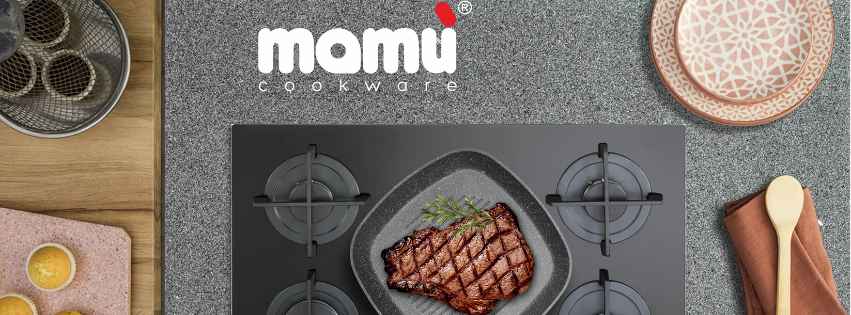
Has this ever happened to you? You buy a beautiful cut of meat from the butcher, heat the grill pan, lay the meat down and… within seconds the pan fills with greyish water. End result: a tough, dry slice that looks exactly like boiled meat.
A disaster, right?
In our latest video, Annachiara answers a customer who found herself in exactly this situation, revealing a key secret: the problem isn't the meat, it's your grill pan.
In the video we'll see why the tools you use make all the difference in the world, but in this article we want to go one step further and explain the science behind a perfect steak.
📺 Watch Annachiara's video
The real culprit: thermal shock in the grill pan
As Annachiara explains in the video, the reason meat releases its juices and “boils” is all about temperature.
When you lay a (cold) piece of meat on a grill pan that is too thin, the pan suffers a thermal shock: its temperature drops instantly. With not enough heat to sear the meat, the water inside escapes, collects in the pan and starts to boil. That's how your grilled meat turns into a stew.
To avoid this culinary drama, you need a grill pan that can keep the heat high and even. Only then can the kitchen's little miracle happen: the Maillard reaction.
What is the Maillard reaction? (The science of the crust)
In the video Annachiara shows us why even heat matters, but what's the practical effect? It's what triggers the Maillard reaction.
Named after the French chemist Louis-Camille Maillard, it's a complex series of chemical reactions that happen when the sugars and proteins (amino acids) naturally present in meat are exposed to strong heat (between 140°C and 180°C).
When this temperature is reached and maintained:
1) Sugars and proteins combine.
2) Hundreds of completely new flavour molecules are created (responsible for the irresistible aroma of roasted meat).
3) Dark pigments form, creating the famous amber crust.
This crust isn't just tasty: it acts as a “shield”, sealing the juices inside the meat and leaving it incredibly tender and juicy when you cut it. If your grill pan cools down, the Maillard reaction will never happen.
The 3 commandments for never “boiling” your meat again
For restaurant-quality cooking at home, follow these simple rules:
- Dry the meat: before it goes on the heat, pat it very dry with kitchen paper. Surface moisture is the number one enemy of the Maillard reaction.
- Use a thin film of fat: lightly oil the meat (not the pan). It helps transfer heat perfectly evenly.
- Choose the right thickness: use a professional, thick grill pan that stores heat and doesn't cool down when it meets cold meat.
The Mamù solution: a grill pan for every hob
At Mamù we know the laws of physics in the kitchen well. That's why we developed thick professional grill pans designed specifically to hold and distribute heat flawlessly, always giving you a perfect Maillard reaction.
And whatever technology you use in your kitchen, we've thought of everything:
- 🔥 If you cook on gas: we have a dedicated line in thick aluminium, light but ultra-responsive to heat.
- ⚡ If you have an induction hob: we have a line with a special integrated base, for even magnetic heat distribution across the whole surface.
Stop boiling your steaks. Watch Annachiara's video to understand the mistake, then discover the grill pan collection in our shop and turn every dinner into a chef's experience!


